What kind of structure is 'uraski' mentioned in the single-bevel kitchen knife description?
I encountered an unfamiliar word while reading an explanation of kitchen knife craftsmanship. I am curious about the reason and purpose of hollowing out the back of the blade.
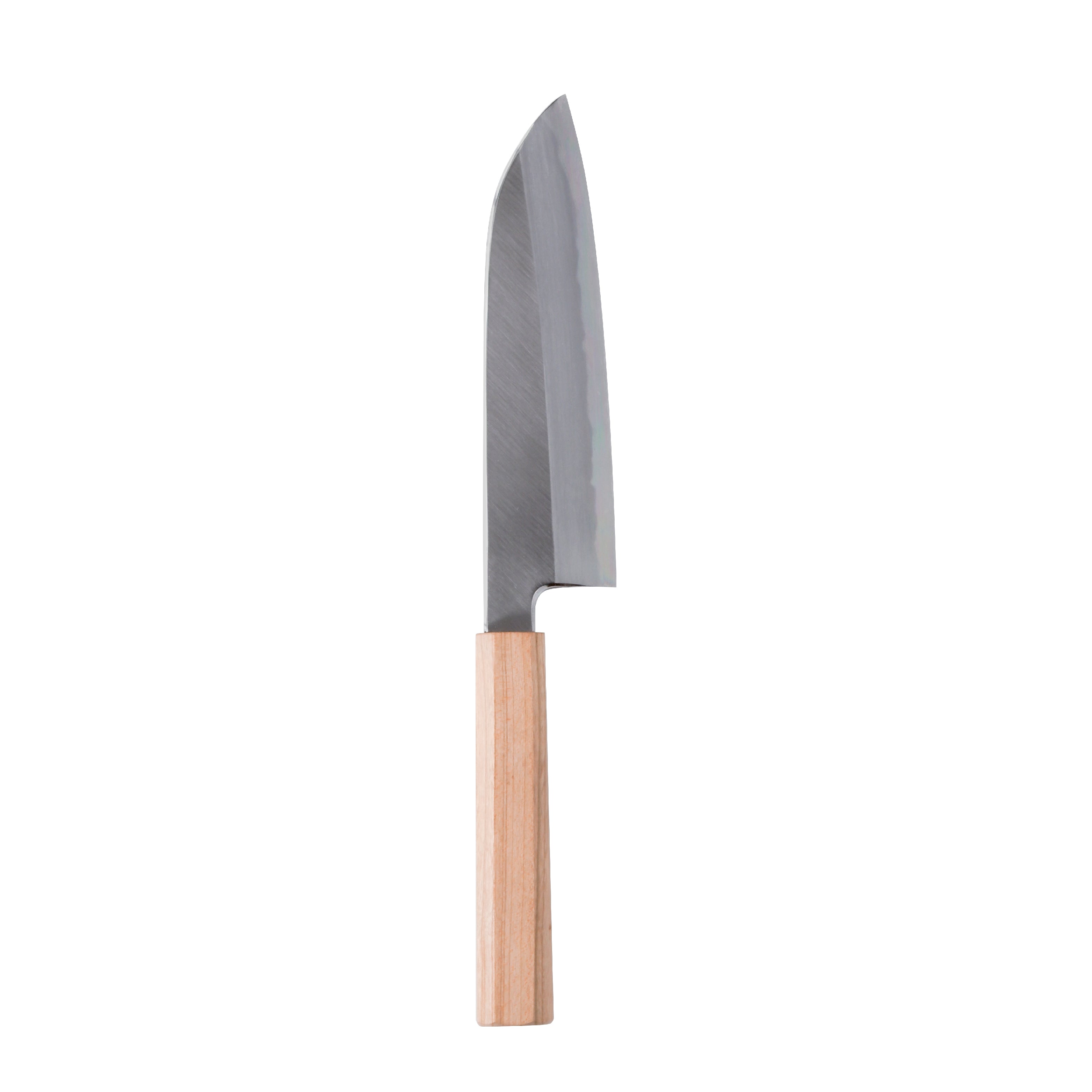
Uraski is a processing method in which the back of a single-bevel knife, sharpened on only one side, is concavely hollowed out to help prevent food ingredients from sticking.
Uraski refers to a treatment that hollows out the inner back of a single-bevel kitchen knife sharpened at an angle on only one side. Unlike common kitchen knives sharpened on both sides, this is a traditional craftsmanship seen in knives sharpened by grinding down only one side at an angle.
Among KAMA-ASA's kitchen knives, those finished with a single bevel have this concave uraski on the back and have a shape where the thickness varies toward the tip of the blade[1]. When the back of the knife is not completely flat but slightly hollowed out in the center, an air pocket forms between the blade and the surface of the ingredient as it cuts through, allowing sliced food to fall away naturally without sticking to the knife. It also helps ingredients cut cleanly without their cross-sections getting crushed by reducing surface friction.
This concave structure also plays an important role when sharpening and maintaining the knife. If the entire back were flat, you would have to grind down the entire wide surface when placing it against a whetstone, but if the inside is hollowed out, only the outer rim touches the whetstone, making it easier to sharpen the blade evenly. It is a design that helps maintain the neat level of the blade edge even when the knife is sharpened and used multiple times.
The concave depth or specific processing dimensions of uraski have not yet been confirmed.
Product measurements
View details
Life Kitchen Knife mina perhonen × KAMA-ASA
Other stated figures
| Part | Value |
|---|---|
| 무게 | 150g |