Why is the length of one side kept the same even though the octagonal plates are different sizes?
When reading the octagonal plate guide, there is an explanation that the length of one side is standardized across different sizes. This question aims to explore what convenience this standard provides in an actual kitchen.
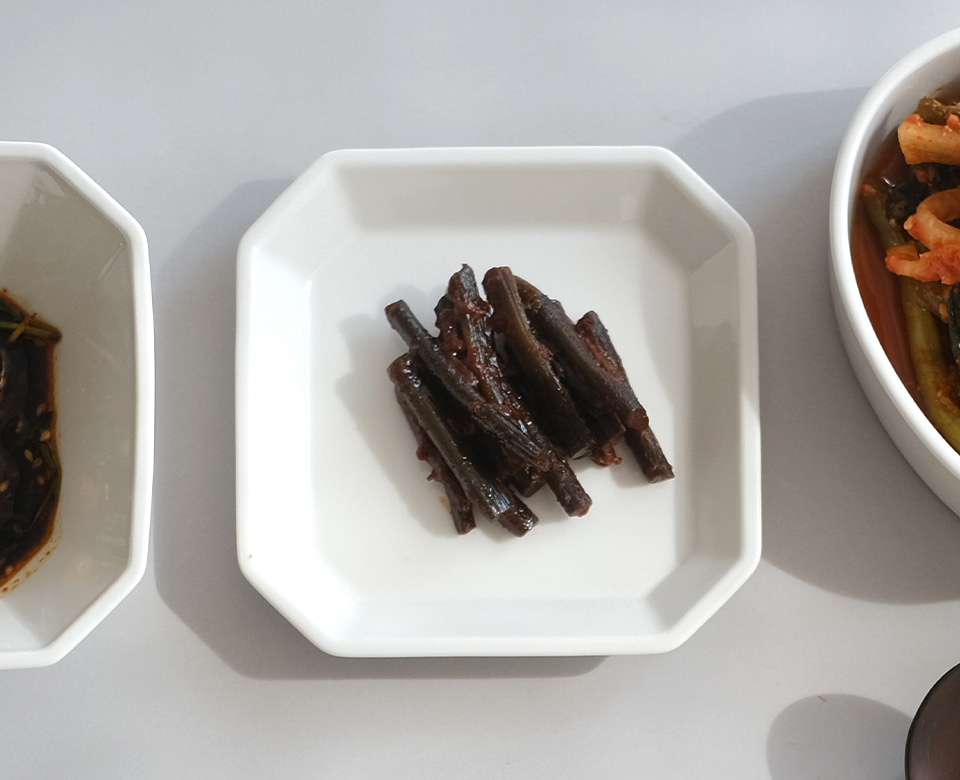
![[호리에] h+ 팔각 접시 (4size)](https://img.hmmm.pub/brands/horie-touki/products/ea20c68e-d514-4009-8ef2-738b71d1bd83/1.jpg)
It is a design that aligns the edges so that plates of different sizes can be stacked in layers stably without wobbling.
The stacked storage mentioned in the description refers to an organizing method where dishes are stacked neatly on top of one another. The octagonal plates from HORIE TOUKI come in a total of four sizes[1], and even though the sizes differ, the length of each outer side is made to be identical across all of them[2].
If the edge dimensions of polygonal tableware differ according to size, their centers easily become misaligned and tip over when stacked upward. However, when the lengths of the interlocking sides are standardized, small plates can be placed on top of large plates without gaps, fitting together securely without wobbling. This means that when storing them in a cupboard, they can be stacked high in one place rather than taking up separate floor space for each plate.
The specific diameter and height dimensions for each of the four plate sizes have not yet been confirmed in official materials.